


Pharmacies and chemists will produce waste every day. They could operate within a hospital, supermarket or on their own premises. Managing waste items and ensuring they are safely disposed of will protect pharmacists, technicians, patients and the environment.
The volume of pharmaceutical waste can only be estimated in the UK. A report by the Department of Health suggests unused medicines cost the NHS £300 million every year, and £110 million worth of medicine is returned to pharmacies.
Teams should be aware of the waste types they will commonly manage, how they should be separated, and what disposal containers will offer the most appropriate levels of protection.
What waste is found in a pharmacy?
Pharmacies will manage waste items, including:
- Expired and damaged medications
- Returned medications
- Controlled drugs
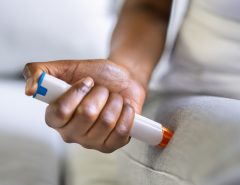
- Sharps items, including syringes and needles
- PPE
- Pharmaceutical items for varying conditions, including cytotoxic and cytostatic materials
As a first point of contact for many patients, pharmacies need to be predictive of the challenges that they may encounter. For those that provide waste collection programmes, this includes the variety of waste medications that they could be disposing of.
How should pharmaceutical waste be handled?

Medicinal waste will be placed in blue containers, as per the waste collection colour code. Examples of these items include expired medicines (excluding cytotoxic and cytostatic drugs), testing kits, and pharmaceuticals returned by the public. The blue container ensures specialist waste management teams can recognise what waste is present, and ensures it is appropriately incinerated or is subject to specialist treatment.
Medicine waste takes many forms. This includes pills, liquids or powders, as well as gels, patches, ointments or aerosols. Any material delivered by sharps will need to be discarded into an appropriate sharps waste bin.
Liquid medicines should not be disposed of in the sewer system via a drain or sink. Instead, they should be disposed of within the appropriate colour-coded receptacle.
Inhalers contain active pharmaceutical ingredients (APIs), which means they should be disposed of through either incineration or a dedicated pharmaceutical aerosol recovery process. These require slightly different management due to the greenhouse gas propellants used in metered dose inhalers.
For further information on safe management, clinicians can refer to Health Technical Memorandum 07-01: Safe and sustainable management of healthcare waste (HTM 07-01).
How do you manage cytotoxic and cytostatic pharmaceutical waste?
If the pharmacy is managing cytotoxic and cytostatic waste, for example, drugs used in cancer treatments, there must be a waste workflow in place for any excess and expired items.
Cytotoxic and cytostatic drugs affect the cell growth of organisms and, therefore, must be carefully managed. Pharmacists should keep these items in designated containers, marked by purple colouring as per the HTM 07-01 colour code.
What are the procedures surrounding the disposal of controlled drugs?
Controlled drugs should be safely stored in a locked container prior to disposal, as per HTM 07-01. Controlled drugs require denaturing prior to final disposal, which involves the use of a controlled drugs denaturing kit, with the resulting kit being disposed of into a blue pharmaceutical container. Schedule 1 and 2 stock-controlled drugs can only be destroyed in the presence of a person with sufficient authorisation, and all members of the team should be able to recognise said individuals in their team.
When these items are destroyed, they should be recorded in the controlled drugs register, using the following information:
- The name of the controlled drug
- Its form
- Its strength and quantity
- The date of destruction
- The signature of the authorised witness of the destruction
- The signature of the person witnessing the destruction (making a total of two signatures)
How do you safely manage non-sharps and sharps waste?

The type of container used for each waste item will depend on the hazards it presents. Two of the most common solutions are a waste bag or a solid, puncture-proof sharps bin.
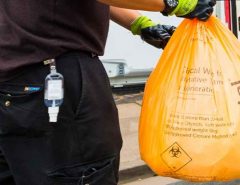
If a waste item is soft or has no sharp hazards, it is safe in a clinical or offensive waste bag or a less rigid container, depending on the potential risk of infection. These can be placed throughout a pharmacy and handled with ease. Each bag must be individually labelled or tagged. If a bag is stored in another container, at a minimum, the lid and/or label should also be colour-coded in line with HTM 07-01.
Each sharps item, including syringes and needlesticks, must be placed in a sharps bin. They could pierce a plastic bag, and present an injury and often a cross contamination hazard. Items disposed of in a sharps bin must never be removed, and the lid must be sealed when it is not in use.
What is the waste colour code?
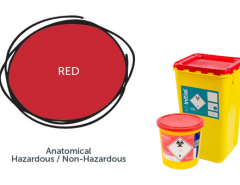
A pharmacy will not only handle medicinal waste items. Therefore, it’s important to be aware of all other aspects of the colour code. HTM 07-01 lays out the following guidance:
- Yellow – for highly infectious, medical and anatomical waste that requires incineration or alternative treatment
- Orange – known infectious items that have come into contact with an ill person
- Purple – cytotoxic and cytostatic waste, see above
- Yellow and black (tiger stripe) – offensive or hygiene waste, which is non-infectious but could otherwise be unpleasant
- Red – anatomical waste
- Blue – medicinal and pharmaceutical waste
- Black – municipal items
Essential regulations and guidance
Further guidance for waste management in a pharmacy or chemist can be found in a number of places. The following documents and regulations will be helpful to review:
- Health Technical Memorandum 07-01 – guidance for waste workflows, including waste colour-coding
- Health and Safety (Sharp Instruments in Healthcare) Regulations 2013 – guidance for managing hazardous sharp items
- The Controlled Waste (England and Wales) Regulations 2012 – defines “clinical waste” and “offensive waste”
- The Hazardous Waste (England and Wales) Regulations 2005 – regulates the movement of hazardous waste through England and Wales to its point of disposal
Support from Initial Medical
Managing waste in the pharmacy or chemist isn’t a task you need to take on alone. Initial Medical, a leading specialist waste management service, is able to provide support with waste containers, waste segregation, and waste collection. With decades of experience in handling highly sensitive pharmaceutical and medical waste, the team is equipped to answer your questions and provide tailored support.
We also offer a full range of regulatory-compliant and colour-coded waste containers, including sharps bins that make up part of our sustainable range.
Colour-coded and available in a range of sizes, there will be a perfect solution no matter what your need.
To find out more, get in touch at 0808 304 7411 or visit the website today www.initial.co.uk/medical
Leave a Reply