


Healthcare services such as GP clinics and medical practices can manage a wide range of waste day-to-day, and need to be prepared to handle and dispose of items safely.
To ensure a clinic has its waste workflow in order, collaborating with a specialist waste management service and regularly reviewing current regulations is key.
What waste is produced in a GP clinic?
Healthcare waste in a GP clinic could include used dressings, PPE, needles and syringes, and expired medications.
Waste items may be from routine care provided in the surgery, but some GP services will accept clinical waste created by patients when they administer care at home, such as prescribed sharps boxes. Where practices accept sealed clinical waste disposal bags/boxes, they still need to describe and classify their contents correctly. This can typically be supported through an understanding of each patient’s treatment plan and the medical waste items it would produce.
Municipal waste items, such as food packaging and office supplies, will also be produced alongside hygiene waste.
What regulations affect waste management in GP clinics?

Clinicians should be aware of guidance and regulations pertinent to healthcare waste management. These include:
- Health Technical Memorandum 07-01: Safe and sustainable management of healthcare waste
- Health and Safety (Sharp Instruments in Healthcare) Regulations 2013
- The Hazardous Waste (England and Wales) Regulations 2005
- Environmental Protection Act 1990
A specialist waste management service can provide guidance on each relevant waste policy.
HTM 07-01 is the foremost place to start when reviewing regulations and is a collection of guidance, regulations, and examples of effective and environmentally-friendly waste management.
Key rules to be aware of include the segregation of waste types, as laid out by the colour code in HTM 07-01. Separate containers are required for sharp items, including any needles and syringes returned by patients.
GPs must also not forget the new Simpler Recycling legislation, which came into effect on March 31 2025, mandating that all workplaces with 10 or more full-time employees must separate their general waste into specific categories. The key change is the requirement to separate waste into at least three categories: mixed dry recycling (including glass, plastics, paper, and cardboard), food waste, and non-recyclable general waste.
How to separate waste in a GP clinic
All waste items should be separated based on the hazards they present. First, identify the waste items physical properties. Sharp items require a puncture-resistant sharps bin; soft items can go in regular waste bins/bags.
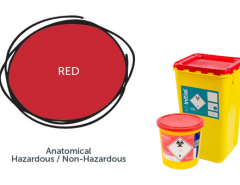
Hazards are also present through the risk of infection, pharmaceutical contamination, and more. The colour code is used to separate waste items based on these risks. GP clinics should use containers in the following colours for the associated hazards:
- Yellow – infectious waste with another hazard (for example, chemical contamination)
- Orange – infectious waste
- Purple – cytotoxic and cytostatic waste
- Yellow and black (tiger stripe) – offensive/hygiene waste
- Red – anatomical waste
- Blue – medicinal waste (including controlled drugs, denaturing kits)
- White with amalgam markings – amalgam waste
- White with gypsum markings – gypsum waste
- Yellow with radioactive symbol – radioactive waste
- Black – municipal waste
- White/clear – recycling
Separating waste in this way protects clinicians, patients, other team members, waste handlers and the wider environment. It ensures each waste item is disposed of appropriately, for example, recyclable products are not landfilled, and chemically hazardous products requiring treatment or incineration are not mistakenly discarded with municipal waste.
Colour-coded posters at points of disposal can help team members keep on top of their segregation requirements.
Where to store waste in a GP clinic
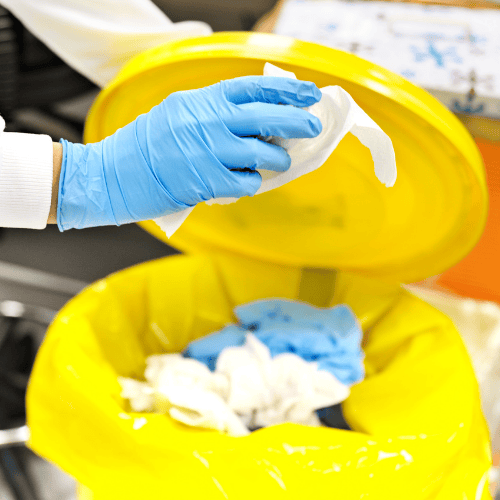
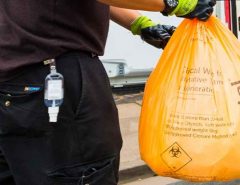
Aside from waste bins at points of use, designate an area for the safe storage of full waste receptacles. Ensure items are secured outside of patient areas. Each container for waste should be labelled with the details to fulfil legal requirements for transport and packaging, as per HTM 07-01. This applies to individual bags as opposed to carts, which may hold the bags.
For bulk storage, individual bags and containers cannot be stored loosely; bagged waste in particular should be kept in fully enclosed, lockable, rigid, leak-proof and weatherproof containers. The lid must be kept closed at all times, aside from when waste is being loaded into or unloaded from the container.
Pharmaceutical, chemical and anatomical waste should be kept inside a secure building; the conditions for outside storage are shown in Table 10 of HTM 07-01.
Healthcare waste management support from Initial Medical
For further guidance on healthcare waste management in GP clinics, the Initial Medical team can provide high-quality support. Knowledgeable technicians can visit clinics and advise on waste management in person or online. If you want compliant waste containers, Initial Medical also provides a range of options for sharps waste and standard clinical waste.
In addition, Initial Medical can aid with waste collection for safe and secure disposal.
Leave a Reply