
For most members of the dental team, waste segregation is little more than a routine part of the working day. The repetitive nature of everyday waste management means the correct bin is chosen almost unconsciously, yet every disposal decision is tightly governed by legislation designed to protect patients, staff and the environment.
Dental practices generate several distinct waste streams, from amalgam and sharps to gypsum and extracted teeth, each with its own risks and disposal requirements. Understanding these not only supports compliance with Health Technical Memorandum 07-01 (HTM 07-01) and the Control of Substances Hazardous to Health (COSHH), but can also reduce practice costs and minimise environmental impact.
Handling amalgam waste safely and legally
Dental amalgam contains up to 50% mercury, making it a hazardous waste that requires its own dedicated disposal route. Bulk mercury is no longer permitted in dentistry, so amalgam is supplied in pre-dosed capsules that should be triturated in an appropriate amalgamator in accordance with the manufacturer’s instructions.
To minimise the risk of mercury entering the environment:
- amalgam waste should always be segregated from other clinical waste
- infectious and non-infectious amalgam should be separated
- amalgam waste containers must be rigid, sealable and puncture-resistant and contain a mercury suppressant
- containers must be labelled with the correct hazard symbols
Dental amalgam must never be disposed of down sinks or with other clinical waste streams. Practices using amalgam are legally required to install separators to capture mercury-containing amalgam particles before wastewater enters the public sewer system.
Unused amalgam, scrap amalgam, spent capsules, and extracted teeth containing amalgam restorations should all be collected in an amalgam waste container before being passed on to an authorised waste contractor for appropriate recovery or recycling wherever possible.
Disposing of study models, impressions, and other dental materials.
Waste segregation is required to support both infection control and environmentally friendly workflows.
Gypsum study models are largely non-infectious because they rarely come into direct contact with patients. However, if disposed of alongside biodegradable matter, gypsum can produce toxic, odorous hydrogen sulphide gas. For this reason, gypsum should be segregated and sent to an appropriately permitted recovery or disposal facility.
Other common dental materials require different approaches:
- Impression materials – After use with a patient, these should be treated as clinical waste.
- Sharps – Needles, scalpel blades, endodontic files, disposable metal matrix bands and any item capable of puncturing a waste bag should be placed in an appropriately sized sharps container immediately after use. NEVER fill containers above the manufacturer’s fill line as this poses a risk of injury, and ensure the lid is always closed aside from when an item is being added.
- Extracted teeth containing amalgam – These should be segregated with amalgam waste. Tooth pots, crown pots or bridge pots can be used where appropriate.
- Personal protective equipment (PPE) – Gloves, masks and aprons should be segregated according to the level of contamination.
- Medicines – Expired or unused medicines should follow pharmaceutical waste guidance and never be thrown in general waste.
Most dental practices have now adopted digital radiography, eliminating the need for processing chemicals. Where conventional film systems remain in use, developer, fixer and lead foil must be segregated and disposed of via the appropriate hazardous waste routes.
Staying compliant with the current regulations
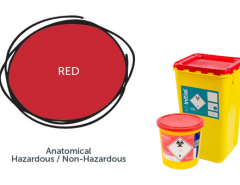
In England, HTM 07-01 provides the framework for classifying, segregating, storing and disposing of healthcare waste in England and is a useful resource for dental teams. Following the guidance helps ensure waste is placed into the correct colour-coded containers and managed safely throughout its lifecycle.
Practices also have a duty of care to remain responsible for waste even after it leaves the premises. This includes:
- maintaining waste transfer notes and hazardous waste consignment notes
- using authorised waste carriers
- ensuring waste is transferred to appropriately permitted treatment facilities.
Regular staff training, clear local procedures and periodic refresher sessions help maintain consistent waste segregation and ongoing compliance.
Tips for minimising waste generation in busy dental practices
Dentistry has evolved enormously over the past few decades; however, this has created a tension between environmental sustainability and the stringent infection control measures in modern practice. Advances have improved patient safety and infection prevention, but also increased reliance on single-use items, disposable products and plastic packaging. While much of this waste is unavoidable, dental practices can still take practical steps to reduce the amount they generate without compromising patient care.
HTM 07-01 promotes the principles of the 5Rs:
- Reduce
- Reuse
- Reprocess
- Renewable
- Recyclable
Simple changes can make a significant difference, including:
- Improving stock control to minimise expired materials
- Avoiding opening single-use items before they are required. Dental nursing staff may be tempted to set up a surgery before the patient arrives, but no-shows or last-minute changes to treatment plans can leave perfectly usable materials and instruments to be discarded.
- Using reusable instruments and devices that can be safely decontaminated and reprocessed
- Adopting digital impressions to reduce alginate study models and their associated waste
- Using digital radiography to eliminate processing chemicals and lead foil
- Segregating waste correctly to avoid unnecessary incineration or hazardous waste disposal costs, adding to a practice’s carbon footprint and wider environmental impact.
Waste reduction is most successful when it becomes part of the practice culture rather than the responsibility of one individual. Everyone involved in ordering, stock management and waste segregation contributes to reducing environmental impact and improving practice efficiency.
Why regular waste audits matter
Waste audits are more than just a compliance exercise. Rather than viewing waste disposal as a routine administrative task, audits encourage practices to review what waste is being produced, whether it is being segregated correctly and where improvements could be made.
For example, an audit may identify frequent disposal of new unopened products due to over-ordering, highlight contamination of non-hazardous waste streams, or reveal recyclable materials that are routinely being discarded as clinical waste. Addressing these issues can reduce disposal costs while helping practices meet their environmental responsibilities.
This is also an opportunity to review staff training and reinforce good practice. Even well-established teams can develop inconsistent habits over time, particularly where new staff members have joined the practice. Regular feedback helps ensure waste segregation remains accurate and that legal responsibilities continue to be met.
Finally, waste audits should not be viewed as a one-off exercise. Monitoring waste generation over time allows practices to measure the impact of changes, identify emerging trends and support a culture of continuous improvement in both environmental performance and regulatory compliance.
Clinical waste management may rarely be the most exciting aspect of dentistry, but it is woven into the safe running of every dental practice.
Initial Medical works with dental practices across the UK, providing compliant waste management services, specialist containers and expert guidance to help simplify the safe segregation, storage and disposal of clinical waste.
Explore Initial Medical’s dental waste management services or contact the team to find the right solution for your practice.