


Over the last two years Coronavirus has taken over the entire world. Everyone’s lives have been affected by the virus in one way or another. The pandemic has raised the importance of infection control for communities everywhere. Measures were put in place such as social distancing, mask-wearing, and hand sanitising in public spaces. However, despite everyone’s efforts, a new strain of Coronavirus, Omicron, has raised the importance of continuous infection control.
What You Can’t See on the Surface
It’s general knowledge in this day and age that sneezing into your hand and immediately touching a door handle, for instance, is a sure way to spread germs. Small respiratory droplets containing the pathogen are expelled when an infected person sneezes, coughs, laughs, or exhales in some way which allows pathogens to linger or land onto someone’s hand.
However, If you were to walk into a public washroom after someone with a virus has just coughed or sneezed you could be at risk because the airborne nature of these pathogens allows them to linger in the air. This also increases the possibility of large amounts of people becoming infected because a lot of people tend to pass through these places.
As well as this, after being expelled pathogens can persist on inanimate objects for some time. A study examining the amount of time Coronavirus can remain on different surfaces revealed that it remains infectious on cardboard for up to 60 hours, stainless steel for up to 80 hours, and on plastic for over 80 hours.2 Another study showed that viruses such as Influenza, Coronavirus, and SARS can exist on surfaces for a few days.3 Gastrointestinal viruses can remain on inanimate objects for up to two months, bloodborne viruses last for around a week and herpes viruses can last from a few hours up to seven days depending on the strain.iii

Helping Hands
People washing their hands is one of the best methods to stop the spread of bacteria and viruses. It’s been one of the first lines of defence in tackling the spread of Coronavirus, as washing hands frequently with soap and water for at least 20 seconds has proven to be one of the most effective methods to prevent the spread of pathogens. Frequent handwashing can therefore be lifesaving. However, research shows that in April 2020 just 35% of people surveyed were washing their hands for 20-24 seconds.5 Another source revealed that just 12% of British adults wash their hands after using the bathroom – public and private.6
Some people may assume that if their hands look clean, they must be safe – but that’s proven to be incorrect. Faeces from people or animals is a source of microorganisms such as Salmonella, E. coli 0157, and Norovirus. These microbes can contaminate people’s hands after they use the toilet or change a nappy, and also through handling raw meat.vii In fact, one gram of faeces can contain one trillion pathogens.iv The spread of these germs can also happen because most people frequently touch their eyes, nose, and mouth, so they can unconsciously ingest the bacilli.
It’s therefore clear that frequent handwashing should be second nature to everyone. But does it really have an impact? Research shows that effective handwashing actually reduces the number of people who get sick with diarrhoea by 23-40%, curtails sickness in people with a weakened immune system by 58%, cuts respiratory illnesses by 16-21%, and lowers gastrointestinal illnesses by 29-57%.vi
Read our blog on the infections you can spread by not washing your hands.
Tackling Germs on Your Surfaces
While people can take protective measures to increase infection control such as social distancing, wearing a mask, and frequently washing one’s hands, it’s clear that effective cleaning is necessary too.
You don’t need to worry about how best to help achieve incredibly clean surfaces, however, because Initial Medical has just the solution you need. The Steri-7 Xtra Surface Cleaning Range has a rapid kill rate of up to 99.9999%* and acts within seconds* so you can be sure that your surfaces are sterile and safe. It is available as a concentrated solution, a ready to use spray, and as surface wipes in order to meet all your infection control needs – the convenience of the wipes allows you to keep up with cleans between patients whereas the spray and solution can be used for surfaces and floors when you have more time.
This range also has a re-moisturising effect to help protect frequent users from skin damage and there is a citrus fragrance option if you would prefer a refreshing scent with your elevated infection control method. Of course, these products are also effective against Coronavirus**.
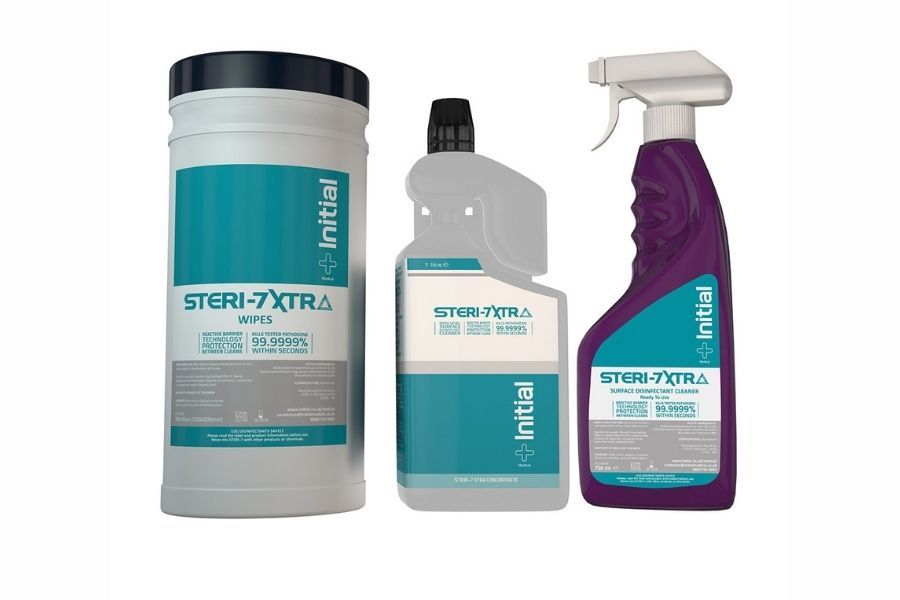
*Source – Steri-7
**Independently tested against feline Coronavirus, a surrogate virus for Coronavirus
2 van Doremalen, N., Bushmaker, T., Morris, D.H., Holbrook, M.G., Gamble, A., Williamson, B.N., Tamin, A., Harcourt, J.L., Thornburg, N.J., Gerber, S.I., Lloyd-Smith, J.O., de Wit, E. and Munster, V.J. (2020). Aerosol and Surface Stability of SARS-CoV-2 as Compared with SARS-CoV-1. New England Journal of Medicine, 382(16), pp.1564–1567.
3 Kramer, A., Schwebke, I. and Kampf, G. (2006). How Long Do Nosocomial Pathogens Persist on Inanimate surfaces? a Systematic Review. BMC Infectious Diseases, 6(1).
5 Heard, H. (2021). Consumer Handwashing Research: Handwashing in a Pandemic.

Leave a Reply