


Waste management workflows are not necessarily one-size-fits-all. Instead, dental practices and healthcare services need to adapt solutions throughout their practice to meet the requirements of set regulations.
By starting small, clinicians can identify effective solutions for every stage of development, from a single surgery practice, to a multi-site success.
Small waste containers
In each individual dental surgery, clinicians need safe waste containers to hand to quickly dispose of hazardous waste, reducing the risk of injury or contamination. Making the most of the space in these rooms is key in avoiding clutter or awkward access to containers, so dental professionals should choose smaller containers that can be collected and stored in bulk.
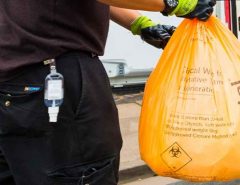
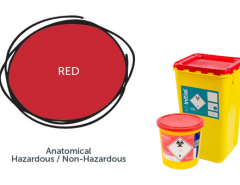
Small containers are best suited for the dental surgery, but they must be colour-coded in line with the requirements set out in HTM 07-01. Common hazards should be accounted for, including infectious and highly infectious waste (orange and yellow containers), offensive waste (tiger stripe; yellow and black), and dental-specific waste, such as gypsum or dental amalgam (white containers, clearly marked with their contents).
Ensure each container should be safe to transport once full (which should be considered as ¾ of its capacity, in order to avoid overfilling).
Amalgam and gypsum waste, most often unique to dentistry, are not often recovered in great quantities throughout a day of care. These containers can be exceptionally small as a result, and save plenty of space in the practice setting.
Helpful colour-code posters can be placed at points of use to ensure each item is disposed of correctly. They can be downloaded for free, and feature images of everyday items to maximise safe waste disposal.
Storage on-site
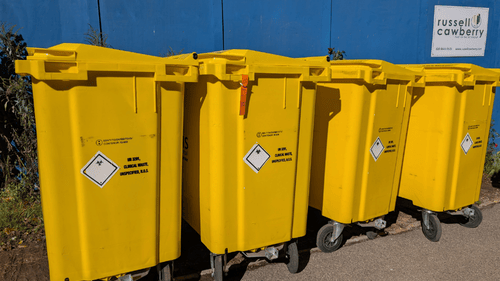
Waste items often have to be held in a safe space on the practice site prior to collection by a specialist waste management service.
Clinicians must safely store waste produced in bulk, without risk of harm to the dental team, patients and the public, and any waste handlers. If a practice has multiple surgeries, the volume of waste can quickly increase, requiring larger bulk storage solutions.
Containers that can be safely locked to limit access are essential, and should only ever be unlocked when adding or removing waste items. Dental teams should analyse the amount of waste they typically produce, and assess the size of container needed for it; traditional-style wheelie bins are often adequate, though they must be colour-coded.
If larger volumes of waste are produced, consider solutions that can take on more waste, but remain safe and easy to manoeuvre – a 1100L wheelie bin, or multiple, is often sufficient for larger practices.
Management across multiple sites
Most practices will only need to focus on the waste responsibilities of one site. However, for professionals operating across multiple locations, it’s vital to keep on top of all dental waste responsibilities.
Working with a specialist waste management service, such as Initial Medical, offers opportunities to find solutions for lone sites, but also review workflows as a wider multi-site business. Initial Medical can recommend effective storage solutions, such as the Griff Pac containers for individual surgeries or bulk wheelie bin containers for a building’s entire waste production.
Our team of experts is also able to audit your workflows, making recommendations that ensure you are compliant with the regulations, but also maximise the space and safety in your practice. Learn more by getting in touch with the Initial Medical team today.

Leave a Reply