
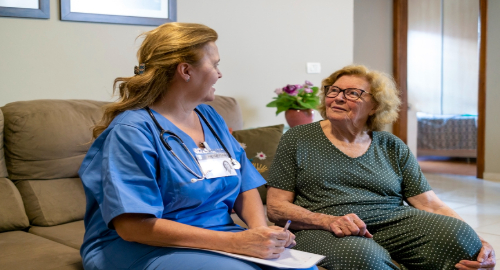

Care homes produce waste every single day, and all items need to be disposed of safely to protect residents and staff.
Managing waste items is also important for regulatory compliance, and ensuring the nursing home provides high-quality care.
What is care home waste?
Nursing home waste includes a range of items, from medical products such as expired medication, used syringes and needles, IV bags and tubing, to colostomy bags and incontinence products. Contaminated PPE and dressings are also common waste items.
Offensive and clinical waste products present a wide variety of risks to professionals.
Staff must be able to confidently manage waste to avoid infection, medical contamination, or injury, such as from a sharp object.
Which regulations affect care homes?

Care home teams need to be aware of the regulations and guidance that affects waste disposal. These help staff implement safe routines in the care home, and provide support if a team member has questions for any waste procedures.
- Health Technical Memorandum 07-01: Safe and sustainable management of healthcare waste – this NHS guidance tells care homes how to operate a colour-coded waste system, and manage risks from various items. It also provides insight on environmentally friendly disposal workflows.
- Simpler recycling: workplace recycling in England – this new regulation means all businesses with more than 10 full-time equivalent employees must separate municipal waste into general waste, dry mixed recycling waste (paper and cardboard, plastic, metal, glass) and food waste. From 31 March 2027, all other firms must comply.
- Health and Safety (Sharp Instruments in Healthcare) Regulations 2013 – this ensures that sharp instruments like needles are managed carefully to avoid injury. This regulation covers every aspect from use, to the disposal of a medical sharp.
The Care Quality Commission (CQC) regularly assesses care homes to ensure they are operating at high standards. They also provide key information for adult social care settings on their website.
Nursing home staff will need to be aware of other key regulations, such as the Environmental Protection Act 1990 and the Hazardous Waste Regulations 2005.
Segregating care home waste
Waste items from care homes need to be separated according to the hazards they present. HTM 07-01 features the waste colour code, which must be followed for all waste generated. It is organised as follows:
- Yellow – infectious waste with another hazard (for example, chemical contamination)
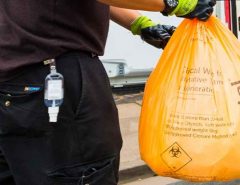
- Orange – infectious waste
- Purple – cytotoxic and cytostatic waste
- Yellow and black (tiger stripe) – offensive/hygiene waste
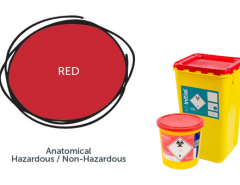
- Red – anatomical waste
- Blue – medicinal waste (including controlled drugs denaturing kits)
- White with amalgam markings – amalgam waste
- White with gypsum markings – gypsum waste
- Yellow with radioactive symbol – radioactive waste
- Black – municipal waste
- White/clear – recycling
Each item of waste will fit into one of these categories, which will be separated even further depending on whether the item is a sharp, solid or liquid.
These will have their own dedicated waste containers. Sharps containers will be strong enough to avoid punctures, and liquid bins need to be leak-proof. Most solid items count as soft waste, such as PPE, so can be placed in waste bags (which are easier to pack away and store).
Colour-coded posters at disposal points can be a simple and effective reminder for staff.
How to store care home waste
Safe storage of waste items is key. It protects staff and residents in the care home.
All waste bags should be no more than ¾ full and no more than 4kg in weight. Clinical bagged waste should be kept in fully enclosed, lockable, rigid, leak-proof and weather-proof bulk containers. Rigid waste containers should be kept safely away from residents.
It’s also important to consider the potential for carrying pathogens from waste storage areas into communal and private resident areas. Hand hygiene stations within storage zones minimise contamination effectively.
Record-keeping for care home waste
Care home teams must meet waste documentation requirements, and safely store written recordings for pre-acceptance audits and annual waste transfer notes, hazardous waste consignment notes, and Environment Agency quarterly returns.
Working with a registered waste carrier ensures this is managed and recorded effectively.
- A written description of the waste items contained
- The correct EWC code(s) for classification, segregation, colour coding and storage
- Quantities, for both non-hazardous and hazardous waste consignment notes
Expert care home waste support with Initial Medical
Initial Medical has supported UK businesses and healthcare systems for more than a century. Established as experts in waste management, you can choose from a variety of Initial Medical services to protect your care home. This includes choosing from the range of waste containers, to organising safe and simple waste collection with the team.

Leave a Reply