


Two years ago, NHS England unveiled the NHS clinical waste strategy. It aimed to improve waste management practices amongst primary care providers to achieve the following:
- Improved efficiency
- Greater sustainability
- Better hospital function
- Reduced environmental impact, in line with NHS net zero carbon commitments
Healthcare professionals can look at the strategy to help formulate plans within their place of care. This includes needing to confidently separate waste types and maximise training efforts.
How does the NHS clinical waste strategy affect healthcare?
The NHS clinical waste strategy is a model that should be followed by all healthcare providers – whether NHS-focused, mixed or private.

It sets out a directive to manage waste appropriately and effectively, aiming for a 20-20-60 waste split:
- 20% of waste goes to incineration (yellow bag, highly infectious waste)
- Another 20% being managed as infectious waste (orange bag)
- 60% being classified as offensive waste (yellow and black, tiger stripe bags).
Approximately 156,000 tonnes of clinical waste are disposed of annually in England alone, with around a third of that being incinerated according to NHS England. It’s estimated that this is done at £617 per tonne. This means incinerating clinical waste alone costs over £32 million a year.
There is also a benefit for the environment when incinerated clinical waste is reduced. The World Health Organisation (WHO) notes that open burning and low-temperature incineration of healthcare wastes can emit dioxins, furans and particulate matter. Each of these can harm both the environment and human health.
Reducing incinerated waste
A reduction in incinerated waste is possible by choosing autoclavable solutions where possible. As well as this, clinicians should look to appropriately classify waste as highly infectious, and therefore in need of incineration, or known infectious, which could be subject to alternative treatment, dependent on the unique characteristics of each item. If items are segregated correctly, we can avoid them being incinerated unnecessarily, where other solutions are possible.
To find out the specifics of each waste type, visit our blogs on orange clinical waste and yellow clinical waste.
Implementing the NHS clinical waste strategy
It’s important that healthcare professionals actively work to put new processes in place that build upon the NHS clinical waste strategy.
This includes training and education for team members, ensuring they recognise which waste systems each product belongs to. The NHS clinical waste strategy notes this is important, with the first professional qualification in NHS waste management created in response.
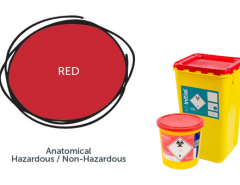
Healthcare providers must ensure they have appropriate colour-coded waste containers at each point of use. Colour-coded posters signal which waste belongs in each container, prompting clinicians to segregate all waste items accurately. This helps ensure only the items that require incineration are designated as such, reducing their environmental impact.
Initial Medical provides clinicians with a range of colour-coded waste containers, from the Griff Pac, which is ideal for dry and wet items, to eco-friendly sharps containers built to protect clinicians, patients and the environment. They also provide free-to-download colour code posters, which help clinicians identify which waste stream to use at a given moment. To find out more, contact the team today.


Leave a Reply