Navigating pharmaceutical waste: a guide for UK healthcare
As the healthcare industry expands to meet the needs of a growing and ageing population, so does the volume of pharmaceutical waste generated.
The disposal of pharmaceuticals is an important part of the clinical workflow and should be a key consideration for all healthcare providers.
Improper waste management, and its resulting harms to the environment and public health, is completely avoidable. Compliance failure also creates legal consequences for healthcare providers.
With official guidelines to direct waste management activity, including the Health Technical Memorandum 07-01 (HTM 07-01), and further support available from a specialist waste management service, such as Initial Medical, there is no excuse for poor waste practices within healthcare
What is pharmaceutical waste?
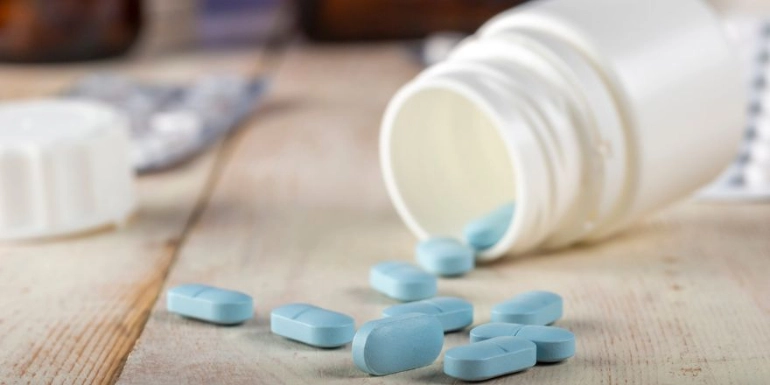
Pharmaceutical waste denotes medicines that are expired, recalled, or contaminated. These are therefore not safe for use nor safe to dispose of through standard waste streams.
Clinicians will also need to consider the disposal of medical delivery devices (sharps, including needles and syringes containing residual liquid) and other items that may be heavily contaminated during the handling of pharmaceuticals, such as vials, bottles, and connecting tubing, and any personal protective equipment (PPE) that contains pharmaceutical residues.
Different categories of pharmaceutical waste require different disposal methods. Clinicians need to be aware of the different hazards presented by pharmaceutical waste items and how these change their disposal requirements.
How to safely dispose of pharmaceutical waste
Effective segregation is the foundation of safe and compliant pharmaceutical waste management. This should take place at the point of disposal.
The prohibition on mixing hazardous and non-hazardous waste does not apply to domestic households; however, patients who self-medicate and produce pharmaceutical waste as a result may be prescribed the relevant waste containers to ensure appropriate segregation, for example, if they create cytotoxic/cytostatic waste. Collection provisions should also be in place.
For pharmaceutical waste, segregation can be achieved using the following waste containers:
- Blue-lidded bins: medicinal waste, including denatured controlled drugs, expired medicines and those returned to a healthcare practice by the public
- Purple-lidded bins: cytotoxic and cytostatic waste and any materials contaminated with them
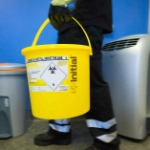
- Yellow-lidded sharps bin: sharps contaminated with pharmaceutical residues that are not cytotoxic or cytostatic, and infectious waste with a pharmaceutical hazard
Cytotoxic and cytostatic medications
Among the most powerful drugs used in healthcare settings, cytotoxic and cytostatic medicines possess one or more of the following hazards:
- Acute toxicity
- Carcinogenic (cancer-causing)
- Toxic for reproduction
- Mutagenic (capable of inducing a genetic mutation)
- Cytotoxicity
Cytotoxic means harmful to the cell, causing either cell damage or cell death, and cytostatic means suppressing the growth and multiplication of the cell. Both medications are used in chemotherapy cancer treatment, creating chemotherapeutic waste that must be carefully managed through proper segregation.
Specifically, as per the HTM 07-01 clinical waste colour code, cytotoxic and cytostatic waste should be placed in the purple waste container, which requires high-temperature incineration (HTI).
For patients self-administering anti-cancer medication at home, clinicians have a responsibility to provide a waste container relevant to the medication being administered, such as a purple-lidded cytotoxic/cytostatic sharps bin, and sufficient training in safe disposal.
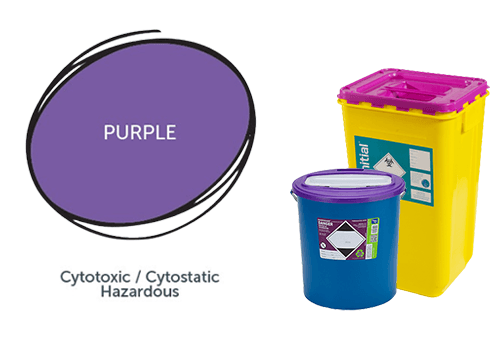 Purple color-coded cytotoxic and cytostatic hazardous waste containers.
Controlled drugs
Controlled drugs are substances that are considered dangerous or harmful to human health and are likely to be misused, risking harmful effects.
The Misuse of Drugs Act 1971 classifies substances according to their perceived harm, and creates offences for unlawful supply, production, and possession.
In response, the Misuse of Drugs Regulations 2001 sets out exemptions to the offences of possession, production, supply and administration of controlled drugs, rendering it permissible for healthcare professionals to possess, supply, and administer controlled drugs while acting in their professional capacities.
This exemption, applied to healthcare professionals, lays out strict regulatory responsibilities regarding the storage, destruction, and disposal of controlled drugs.
The Schedule System specifies the perceived level of potential abuse and the medical value ascribed to each item. It informs how healthcare providers handle, prescribe, and dispose of controlled substances. Pharmaceutical products are first included in Schedule 2, but everyday solutions (dependent on the healthcare environment) are more commonly found in Schedules 3, 4 and 5.
Expired medications
Expired medicines are a known problem. Unused medicines are estimated to cost the NHS at least £480 million a year.
The expiration dates of medicines serve as an assurance of safety and potency of the drug up until, and including, the final day.
Excluding certain medicines, namely insulin, nitroglycerin, and liquid antibiotics, most drugs will retain at least 70-80% of their original potency for at least 1-2 years after expiry, making their use past expiration dates relatively safe. The degree of potency loss after this point is not clear, and adverse effects cannot be entirely ruled out. Accordingly, clinicians must not prescribe expired medicines as they cannot guarantee efficacy. Instead, pharmaceutical products held on site must be regularly reviewed, and those past their expiration date must be discarded.
Minimising pharmaceutical waste through inventory management
Pharmaceutical waste cannot be eliminated from the pharmaceutical lifecycle; however, there are waste-minimising measures that all healthcare professionals should endeavour to commit to. These include:
- Practising First Expired, First Out (FEFO) for drugs stocked, accelerating dispensing of short expiry date medication
- Optimising and reviewing storage conditions
- Coordinating with other pharmacies to exchange medications
- Raising patients’ awareness of pharmaceutical waste and proper disposal routes, encouraging use of take-back programmes and, where applicable, maximising the use of patients’ own medication during hospitalisation
Denaturing controlled drugs
Denaturing, in the context of controlled drugs, means to chemically render these substances irretrievable and therefore unfit for their intended uses. Denaturing must precede disposal during the waste management process to ensure that controlled drugs, and their active pharmaceutical ingredients, cannot be recovered for illicit use and to prevent these substances entering the environment.
Under Regulation 27 of the Misuse of Drugs Regulations 2001, a controlled drug specified in Schedule 1, 2, 3 or 4 (part 1) must be destroyed. Although the method(s) of destruction are not specified in the Regulations, the approach most routinely used by healthcare professionals is chemical denaturing using a controlled drug denaturing kit. This is followed by final disposal via HTI.
Being the least stringently regulated, there is no legal requirement for Schedule 5 controlled drugs to be denatured; they can be deposited in the blue waste container, denoting non-hazardous medicinal waste. Examples include codeine and morphine.
Where there is not a requirement for an authorised witness to be present for the denaturing of Schedule 3 or 4 (part 1) controlled drugs, Schedule 2 controlled drugs require that an authorised witness, in healthcare settings this will be a controlled drugs accountable officer (CDAO), be present. An accurate destruction record should be maintained and entered into a Controlled Drugs Register.
For healthcare professionals authorised to possess, produce, supply, and administer controlled drugs, proper destruction by denaturing ensures regulatory compliance and prevents drug misuse.
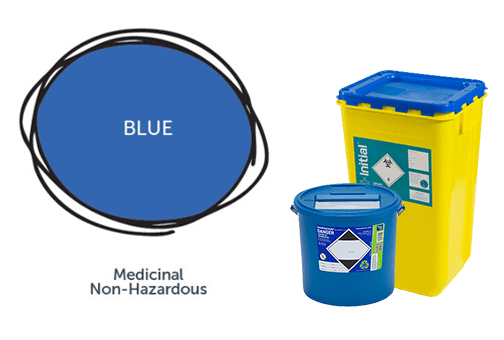 Blue containers for non-hazardous medicinal waste disposal.
The role of the community pharmacist in pharmaceutical waste disposal
Medicine take-back programmes are an underutilised resource within healthcare waste management, and should be encouraged to reduce improper disposal methods at home.
As with all clinical waste, there are requirements for what can and cannot be returned to community pharmacies as part of medicine disposal programmes. Community pharmacies are able to accept unwanted or expired medications, prescription medications, over-the-counter medicines, and controlled drugs. The following items cannot be accepted by pharmacies and require disposal by alternative means:
- Needles
- Syringes
- Sharps
- Dressings and bandages
- Non-medicinal waste (veterinary products, chemicals, and non-pharmaceutical chemicals)
Being on the frontline of medicine safety, pharmacists can play an active role by giving instructions to patients on pharmaceutical disposal practices and raising awareness of the take-back programmes.