Clinical waste disposal in healthcare services is not always straightforward. A variety of waste items will
be produced every day, in various quantities, during different procedures. Each waste item needs to be
assessed for the hazards it presents, and to ensure these are responsibly managed, items should be
segregated in line with the waste colour code.
Health Technical Memorandum 07-01 (HTM 07-01) is a primary source for advice on the topic, with a
clear definition of the clinical waste colour code. This helps professionals to be able to confidently sort
items into appropriate containers with similar types of waste products, streamlining the disposal
workflow later down the line.
Understanding how waste segregation works is vital for the safety of patients, professionals, and clinical waste handlers.
How to properly segregate different types of clinical waste
Waste segregation begins at the source. Once an item is used and is discarded, a clinician must make a judgement on the types of hazards present. Typically, this will be a mostly unconscious task, but this can only be reliable when appropriate training has taken place.
For example, sharp items, including needles and syringes, will present different risks to PPE and paper
tissues. Whilst the latter may be heavily contaminated, the inherent risk of percutaneous injury means
sharp items have a different clinical threat. As a result, professionals will require a sharps bin, which is
more rigid than traditional clinical waste bags. This way, punctures can be minimised, and access to the
contents will also be restricted. This also removes the chance to retrieve waste items, which would be a
high-risk activity.
How a product is contaminated will also change how it is segregated from other waste items. HTM 07-01 defines clear waste groups, including cytotoxic and cytostatic, known infectious, offensive, anatomical, pharmaceutical, and more. The risks an item possesses change how it must be handled. For example, highly infectious items will require incineration in many cases, whereas dental amalgam can undergo recovery methods.
Municipal and recyclable waste will, of course, be produced on site and are the clearest representation
of the need for waste segregation, because both have different disposal/recovery workflows.
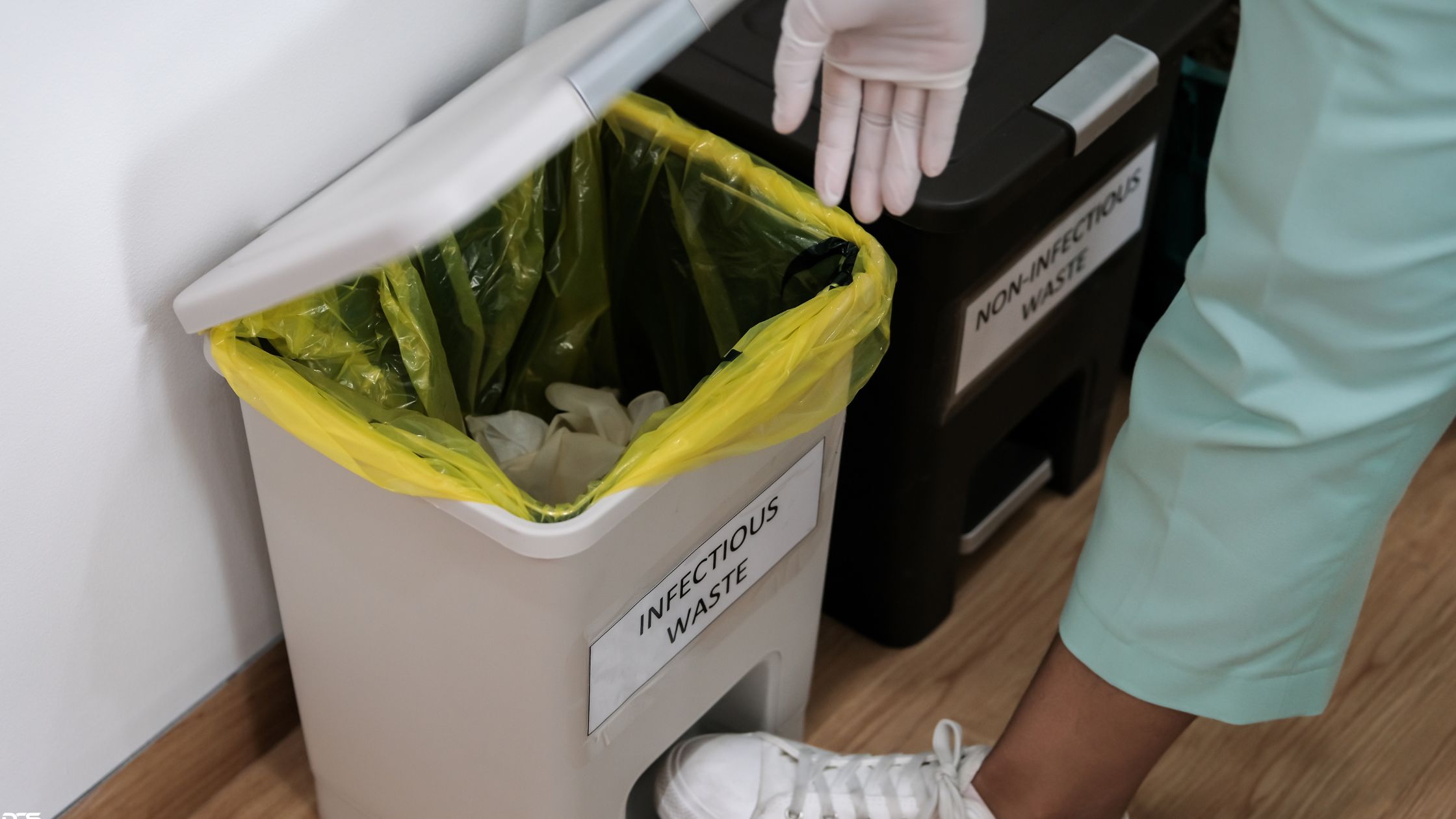
An appropriate variety of clinical waste containers should be located close to the point of use to simplify segregation and ensure safe disposal. So clinicians understand at a glance which container to use; these are differentiated by colour and labelling.
Colour-coding guide for clinical waste bags and containers
The clinical waste colour code is laid out in HTM 07-01 and is available on free-to-download posters from Initial Medical.
It helps with clinical waste segregation, and is as follows:
●Yellow – infectious, medical and chemically contaminated waste. Examples include IV bags,
pharmaceutically contaminated sharps, and chemically contaminated laboratory waste.
● Orange – known or potentially infectious waste. This includes infectious dressing and swabs, as
well as phlebotomy needles/syringes.
● Purple – cytotoxic and cytostatic waste. An aggressive form of pharmaceuticals, it may be
produced during chemotherapy treatment, for example.
● Yellow and black (tiger stripe) – offensive and hygiene waste, which is typically unpleasant but
not highly hazardous. It may feature used but non-infectious PPE, couch roll, non-infectious
items contaminated with blood and other bodily fluids, and more.
● Red – anatomical waste, such as amputated tissue, full and partial blood bags and blood
preserves.
● Blue – medicinal waste, such as expired medicines, testing kits, and medication returned by
members of the public.
Additional waste containers will be required in dental settings, where amalgam and gypsum waste are
commonly produced.
Not all of these categories allow for sharps containers. For this reason, a mix of the colour code and
physical properties needs to be considered when discarding items. A medicinally contaminated needle
will go into a yellow sharps container, whereas a non-medicinally contaminated needle, such as those
used to take blood samples, will go into an orange sharps container.
The chosen containers for a healthcare service must be designed in line with pertinent regulations. Initial Medical provides a wide array of solutions, each designed with everyday workflows in mind.
The impacts of incorrect waste disposal
Incorrect waste disposal creates three key risks:
● The potential for physical harm
● Negative environmental impacts
● Costly financial outcomes
Physical harm can come from unexpected exposure to sharp objects and infectious items. However, with appropriate waste storage and the use of PPE, waste handlers will not be exposed to risks that cause more than surface-level harm.
Environmental risks may arise when an infectious item is not properly managed; for example, if it is sent
to landfill rather than for incineration, there is a chance it could harm the surrounding wildlife and
environment. This is especially the case for items such as amalgam waste.
Following HTM 07-01 also ensures clinicians appropriately segregate items, safely reducing the volume
that ends up in incineration. Previously, some professionals may have been prone to overestimating the risk posed by an item, increasing the number of waste items being incinerated. This disposal method is, understandably, not good for the environment, and so appropriate segregation that increases the use of alternative disposal approaches is vital.
Finally, waste methods such as incineration are expensive. It is reported that 52,000 tonnes of clinical
waste are disposed of every year at £617 per tonne – totalling more than £3.2 million. By reducing the volume of waste being incinerated by appropriately segregating waste items, the cost to healthcare
services can be reduced.
Best practices for training staff
Team training programmes ensure that all members of staff can segregate waste workflows with
confidence. They should be knowledgeable about the types of waste covered by the colour code, know the types of waste they may encounter in their work and which items are placed in each type of waste container.
Simple reminders are possible with effective signage at points of disposal. These act as a final reminder or help professionals decide on an item if the lines seem blurred.
Initial Medical provides free-to-download colour code guides, as well as comprehensive CPD-online
training and practical Face to Face training, alongside expert guidance from our consultants. Each
interaction brings healthcare teams closer to optimal compliance and confidence in their workflows. Get in touch today to learn more.