High-traffic entrances, lobbies and corridors in commercial buildings face constant footfall that quickly wears down flooring and increases slip hazards in wet weather. Every visitor has the potential to track in dirt and grit on their footwear, which acts like sandpaper on your floor surfaces, causing micro-scratches, dulling protective finishes and damaging carpet fibres.
Standard cleaning and off-the-shelf mats fail to stop this damage. Installing high-performance commercial floor mats stops abrasive particles and rain moisture at the doorway before they spread throughout your facility.
Integrating targeted floor protection into your facility management strategy preserves your floors, simplifies maintenance, reduces long-term costs, and keeps staff and visitors safe.
This article covers:
- The hidden costs of unprotected floors
- Building a targeted floor mat strategy
- Why a managed floor mat service makes financial and operational sense
The hidden costs of unprotected floors
Neglecting floor protection in high-traffic areas can lead to costly operational failures. Without proper safeguards, heavy foot traffic deteriorates floor surfaces, increasing maintenance costs and exposing your facility to significant safety and liability risks.
Premature floor damage
On hard surfaces such as vinyl, polished concrete or wood, the constant friction of foot traffic wears down protective coatings, causing tiny scratches that trap dirt and make floors look dull, no matter how often they’re cleaned. In carpeted areas, small grit particles sink deep into the fibres, where they cut into the backing with every step. This accelerates wear, leading to thinning and matting that can lead to costly replacements sooner than expected.
Inflated cleaning expenses
It’s more cost-effective to prevent dirt from entering your building than to clean it up afterwards. Studies show that as much as 80% of the dirt inside a commercial space is carried in on shoes.
Without suitable matting at entry points, dirt from footwear is spread into offices, hallways and common areas. This will result in the need for a higher level of cleaning and extra costs:
- Higher labour costs: Cleaning staff spend increased time vacuuming, mopping and treating larger floor areas.
- Greater chemical and water use: Deep cleaning requires more cleaning products and water.
- Faster equipment wear: Vacuum cleaners, floor scrubbers and polishers operate longer, increasing maintenance needs and reducing their lifespan.
Slip and trip liability
According to the Health and Safety Executive (HSE), slips and trips accounted for 30% of non-fatal workplace injuries in the UK in 2024/25, making them the leading cause of reportable accidents. Wet shoes on smooth, hard floors can become dangerously slippery.
According to the UK Health and Safety at Work etc. Act 1974 and the Workplace (Health, Safety and Welfare) Regulations 1992, employers and building managers have a legal obligation to ensure floors are safe, well-maintained and free from slip risks.
It is better to take proactive steps, such as installing high-absorption mats at entry points to remove water before it spreads across polished floors, keeping employees and visitors safer.
Building a targeted floor mat strategy
Many businesses rely on a single, generic mat thrown down by the front entrance. A lone mat might catch the worst of the mud on a quiet day, but under heavy footfall, it quickly becomes saturated, ineffective and messy.
Protecting commercial flooring requires a tailored, multi-zone strategy that removes as much dirt and moisture as possible from footwear near the entrance area, before people walk farther into the building.
The three-zone entrance defence
To keep dirt and moisture from entering your building, you need to think in zones. Initial recommends a simple three-step approach at every main entrance:
- Zone 1 (exterior): Placed just outside the entrance door. Heavy-duty scraper mats with rigid ridges or studs knock off coarse grit, gravel, and heavy mud before shoe soles cross the threshold.
- Zone 2 (primary interior): Positioned immediately inside the doorway. These mats combine tough, scraping fibres with absorbent yarns to catch fine dust and absorb most incoming water.
- Zone 3 (secondary interior/ foyer): Stretched across the reception area or main corridor. High-absorbency carpet mats wipe shoe soles completely dry before visitors step onto smooth hard flooring or internal carpets.
As a rule of thumb, it takes roughly three to four metres of continuous matting, which is about six to eight strides, to remove up to 90% of tracked-in dirt and moisture.
Ergonomic support for standing workstations
Floor mats aren’t just for trapping dirt; they are vital for worker health. If you have employees standing in one place for hours at a time, whether behind a reception desk, at a retail till, or along an assembly line, hard floors put immense strain on their lower back, knees and ankles.
For these areas, you can use specialised anti-fatigue rubber mats. Designed with air-cushioned domes or ergonomic cell structures, they force the small muscles in the feet and calves to make constant micro-adjustments. This subtle movement acts as a pump, encouraging healthy venous blood flow back to the heart, preventing joint stiffness, and keeping staff far more comfortable and alert throughout their shift.
Heavy-duty protection for wet and industrial zones
In commercial kitchens, food preparation areas or workshop floors, standard entrance mats are inadequate. Grease, cooking oils and industrial chemicals quickly break down standard rubber backings, causing mats to curl up at the edges and create serious trip hazards.
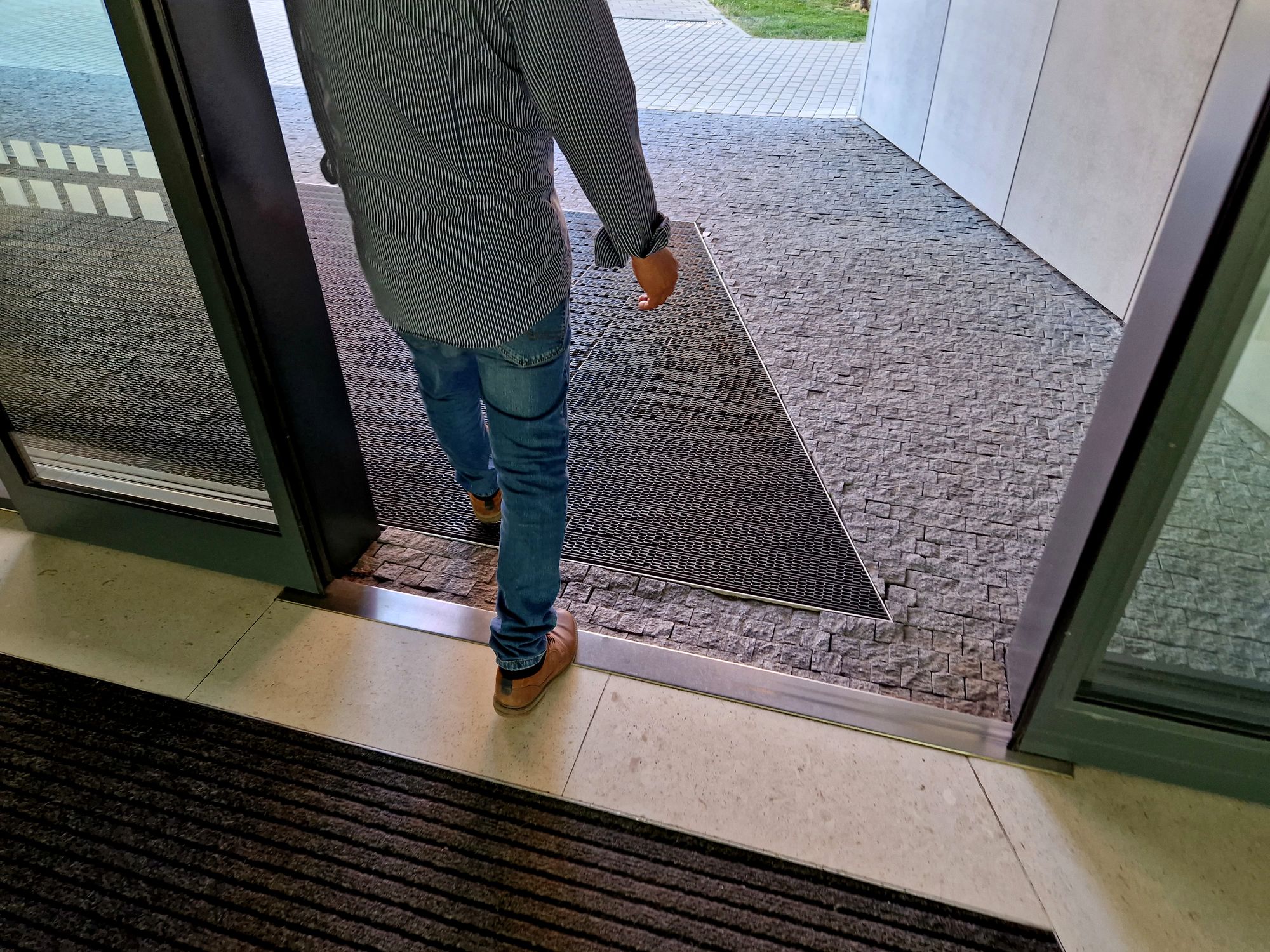
For these environments, there are grease and chemical-resistant nitrile rubber mats, such as Initial’s Microfibre Plus range. These mats feature integrated drainage holes and raised underside studs. Spilt liquids and food particulates pass straight through the holes rather than pooling on top, keeping the standing surface clean, dry, and slip-free even in the messiest conditions.
Why a managed floor mat service makes financial and operational sense
On paper, purchasing mats outright often looks like the most cost-effective option. It appears as a one-off capital expense, avoiding ongoing contract costs. In practice, however, direct purchase rarely holds up over time.
The issue stems from how floor mats function under heavy footfall. Without specialist laundering, even the highest-quality mats eventually stop working.
The performance limit of purchased mats
A commercial floor mat works by trapping dirt and moisture between its synthetic yarns. However, standard daily facilities vacuuming and spot-cleaning can only remove the top layer of surface debris.
Over time, fine grit, road salt and oils lodge deep at the base of the pile, beyond the reach of standard vacuum suction. As these trapped solids build up:
- Fibres mat down: The soft yarn becomes crushed and compacted, losing its capacity to absorb water or scrape shoes.
- Moisture stays on top: Once saturated, water remains on the surface of the mat rather than draining away, causing shoes to pick up moisture and track it directly onto surrounding hard floors.
- Backings degrade: Repeated cleaning with standard floor chemicals can break down rubber backings, leading to curled edges, rippling and increased trip risks.
When a purchased mat fails, facilities teams are left with a simple choice: accept a scruffy, ineffective mat that creates a safety hazard, or purchase an expensive replacement.
How a managed service preserves performance
A managed floorcare service replaces static product ownership with an ongoing operational schedule. Instead of leaving mats to degrade in place, a “lift and lay” rotation system keeps floor protection working at peak efficiency.
- Deep industrial laundering: Off-site washing facilities use heavy-duty extraction to remove fine abrasive grit that standard vacuums leave behind. High-temperature washing strips away stubborn grease, while controlled tumble drying heat-resets synthetic fibres, springing them back into an upright position to restore full absorbency.
- Seamless operational continuity: Soiled mats are lifted and immediately replaced with freshly laundered ones on a fixed schedule (such as weekly or fortnightly) aligned with your building’s footfall. This exchange is done discreetly, preventing any gaps in floor coverage or disruption to daily operations.
- Continuous compliance and safety checks: Every mat brought into a service centre undergoes quality checks. Backings are inspected for flexibility, grip and flat-laying edges. If a mat shows signs of structural wear, it is repaired or retired, ensuring your business stays compliant with HSE guidelines without requiring internal monitoring.
- Shift from CAPEX to OPEX: Rather than dealing with unexpected capital expenses when mats wear out, a managed service converts floor care into a predictable operational fee, ensuring long-term budget control alongside guaranteed safety performance.
Protect your premises with a professional floor mat service
High-traffic entryways and busy internal corridors are demanding environments. Left unprotected, they result in hidden costs, from premature floor replacements and inflated cleaning bills to preventable slip-and-trip claims.
A strategic floor mat system addresses these operational risks at the source. By capturing moisture, grit and grease before they spread, and supporting standing staff with targeted ergonomic solutions, facilities teams can protect their premises, maintain regulatory compliance and keep operational budgets under control.
FAQs
What are commercial floor mats made of?
Initial commercial floor mats are made of high-twist nylon fibres engineered to trap dirt, eco-friendly Phoenix Fibre, and durable, non-staining, phthalate-free nitrile rubber backings that lie flat to eliminate rippling and trip hazards.
How often should commercial mats be serviced?
High-traffic locations (e.g. retail hubs, transport centres, schools) require weekly rotation, whereas standard corporate office spaces typically benefit from fortnightly or monthly servicing.
Do anti-fatigue mats really improve safety and productivity?
Standing on hard surfaces restricts blood flow to the lower limbs. Anti-fatigue mats encourage subtle postural adjustments that stimulate blood flow, reduce lower back pain, lower fatigue and maintain worker alertness throughout shifts.
How does a managed floor service adapt to severe winter weather?
Winter footfall brings significantly higher volumes of water, mud and corrosive road salt into commercial buildings. A managed floorcare service offers operational flexibility, allowing facilities managers to adjust exchange frequencies, moving from fortnightly to weekly rotations during wet winter months, so mats are laundered before reaching complete moisture saturation.
How can Initial Washroom Hygiene’s managed floor mat service support sustainability and our ESG goals?
Initial Washroom Hygiene embeds sustainability into its floorcare solutions across every stage of the lifecycle:
- Recycled materials: Mats use Phoenix Fibre (100% recycled) or ECONYL® regenerated nylon made from ocean and landfill waste.
- Lower energy use: Phoenix Fibre mats dry 40%–50% faster, significantly reducing gas and electricity use during laundering.
- Eco-friendly construction: Durable, phthalate-free nitrile rubber backings eliminate toxic plasticisers and extend mat lifespan.
- Efficient laundering: Off-site processing uses closed-loop water treatment and precise chemical dosing, lowering the environmental impact compared to disposable mats.